For the last six months I tested the most popular cat water fountains sold in the US. Ordered them, unboxed them, ran them in my kitchen, measured them, and watched what my three cats actually did with each one over weeks, not days.
What I learned is this: almost every fountain on the market is built from the same grade of steel, filtered by the same kind of carbon pad, and sold with the same promise. Three of the four I tested grew a slick film on the inside walls within the first week. The cats noticed before I did. One by one they stopped drinking and went back to the bathroom tap.
One fountain did not grow the film. Six months later it still has not. It comes down to three things nothing else in the test had, and I will show you each one.
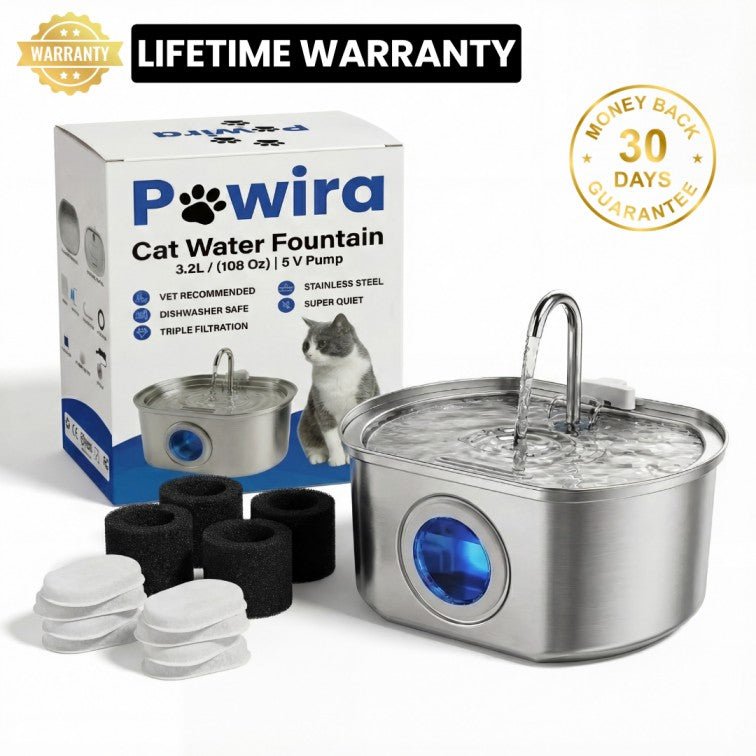
The only fountain in the test with 316 steel on every water surface, a UV lamp that never switches off, and a pump that never stops. Six months in, still no film on the walls and all three cats drinking daily.
Sold on a motion sensor that is supposed to wake the pump when your cat walks up. Mine mostly did not. So the water sat still in a closed tank for most of the day, and by day five it had the same film a bowl gets.
Good looking, all-steel, big tank. But the steel is 304 sold as "medical-grade," the filter has no ion-exchange resin, and the lifetime warranty quietly ends the day you stop paying for filters.
A faucet-style spout that some cats like, attached to the loudest pump in the test, a filter the water partly flows around, and a checkout that signed me up for $29.99 a month without asking.
I have owned cats for twenty-two years and written about cat care for six. Before I bought a single fountain for this test I read every manual I could download, the spec sheets for 304 and 316 stainless steel, and the support pages and return policies of each brand. Then I bought all four at retail with my own card. No review units, no discount codes, no contact with any company beyond the same customer support line you would use.
I went in with eight criteria, decided before the boxes arrived: the grade of steel on every water surface, whether the water keeps moving all day, whether there is any sterilization and whether it actually runs, what is in the filter and what it costs over a year, whether a subscription is attached to anything, noise measured with a meter rather than a claim, how much of the fountain can go in the dishwasher, and what the warranty is worth.
This guide is for you if your cat drinks from the bathroom tap and ignores her bowl. If you have more than one cat and a fountain that seems to work for one and not the others. If you have a senior cat and a vet who has mentioned kidney values. Or if you have already bought a fountain, maybe two, that your cat used for a week and then walked away from, and you are about to buy a third.
If your cat drinks happily from a plain bowl and her bloodwork is fine, you can skip all of this. Most cats are not that cat.
Everything below is either printed on the box, stated in the manual, or measured in my kitchen.
| Pawira | HydroWhisker | Catosaur | KittyStream 2.0 | |
|---|---|---|---|---|
| Steel grade (water surfaces) | 316 | 304 | 304 | 304 |
| Molybdenum in the steel | Yes | No | No | No |
| UV lamp in pump | Yes | No | No | No |
| UV runs continuously | Yes | n/a | n/a | n/a |
| Water always moving | Yes, corded | No, sensor mode | Yes, continuous mode | No, sensor mode |
| Lithium battery under tank | None | Yes | Yes | Yes |
| Ion-exchange resin in filter | Yes | No | No | No |
| Filter interval vs. subscription ships | 2 weeks, no subscription | 2 weeks / ships every 4 | Weekly / ships yearly | 2 weeks / ships every 4 |
| Filter sets in the box | 8 | 2 | 4 | 2 |
| Subscription pushed at checkout | No | Yes, pre-selected, monthly | Yes, annual | Yes, hidden, monthly |
| Warranty tied to subscription | No, lifetime | No | Yes | 1 year |
| Noise, measured at 12 in | 19 dB | 24 dB | 25 dB | 27 dB |
| Whole unit dishwasher safe | Yes | Steel parts only | Steel parts only | Steel parts only |
| Cleaning kit included | Yes | Promo only | No | No |
| Capacity | 108 oz | 135 oz | 135 oz | 74 oz |
| Cats still drinking at month 6 | 3 of 3 | 0 of 3 | 0 of 3 | 0 of 3 |
The HydroWhisker is built around a motion sensor, and the sensor is the problem twice over. When it does not fire, which for Hazel was most of the time, the cat stands there and nothing happens. When it does fire, it pumps water that has been sitting still in a closed tank since the last time a cat walked by. Still water grows film. Film is what a cat smells. Add 304 steel, no UV, and a filter subscription that ships half as often as the FAQ says to change it, and the big tank does not save it.
The Catosaur is the best looking fountain of the four and the one I most wanted to like. It is let down by its steel and its terms. The steel is 304 sold with the phrase "medical-grade," which is true of instruments and untrue of implants. The terms tie a lifetime warranty to an annual filter subscription. A warranty that ends when you stop buying filters is a subscription with extra steps.
The KittyStream 2.0 has a spout some tap-drinking cats will like, and that is where the good news ends. It was the loudest fountain in the test, its support team confirmed a gap that lets water flow around the filter, and its checkout enrolled me in a $29.99 monthly plan I could not cancel from my account. My cats had stopped using it by day two. I stopped recommending it by day three.
I will be honest. I did not expect to end up with strong opinions about cat water fountains.
But after watching my three cats go through four different fountains in two years, I started to notice the same pattern every time. A new fountain arrives. The cats are curious. They drink from it for a few days. Then one by one they stop, and I find them back on the bathroom sink waiting for me to turn on the tap.
I have a twelve-year-old named Hazel who is picky about everything. A seven-year-old named Juniper who will drink out of the dog's bowl before she drinks out of anything that smells off. And a three-year-old named Finn who is the least fussy of the three, which made it easy to tell when something was actually wrong with the water.
The pattern was always the same. Within a week the inside of the fountain developed a slick film I could feel with my finger. I would scrub it out, and within days it was back. The cats always noticed before I did.
So I decided to do this properly. Four popular fountains. Six months. Same three cats. Same spot in the kitchen. Same tap water. A decibel meter, a magnet, and a lot of finger tests.
One of them was in a different category from the rest.
Pawira arrived three days after I ordered, in a branded box with the product printed on the outside. Inside the box, next to the fountain, was a small cleaning kit. Brushes for the pump housing and the spout. None of the other three included anything like it.
The first thing I noticed when I lifted it out was the weight. It is heavier than any of the other fountains. The steel feels smooth and solid in a way the 304 fountains did not.
I filled it to the line, 108 oz, and plugged it in. Then I stood there waiting to hear it. I could not.
Hazel, my picky one, came over first. Sniffed it. Walked away. That is what she does with everything, so I was not surprised.
She came back that evening and drank. Two short sessions. The next morning she was at it before I had made coffee.
By day three all three cats were drinking from it. By the end of the first week I was hearing it from the other room, that soft lapping sound, several times a day. That had never happened with any of the other fountains past the first few days.
Every fountain in this test is sold as stainless steel. Three of them are 304. One is 316. That sounds like a small difference. It is the whole difference.
A 304 fountain sits in chlorinated water twenty-four hours a day. Over weeks the surface develops microscopic pits, and those pits are where biofilm settles. You cannot scrub it out because you cannot reach it.
This is also why surgical implants that stay inside a human body for decades are made from 316, and why 304 is used for instruments that get sterilized and taken back out. One of the fountains in this test markets its 304 as "medical-grade." Technically true. It is the grade you take out of the body, not the grade you leave in.
Pawira is 316 on every surface that touches water. Basin, reservoir, spout. After six months of daily use I have run my finger along the inside walls dozens of times and never once found the film.
All three competitors are wireless. That is a selling point on the box, and for two of them it is a problem inside the tank.
The HydroWhisker and KittyStream both default to a sensor or timed mode to save battery, where the pump only runs when a cat walks up or on a schedule. The rest of the day the water sits completely still inside a closed tank at room temperature. That is a water bowl with a lid on it. When the cat finally triggers the sensor, if it triggers at all, the pump pushes that same still water up through the spout. The Catosaur can run continuously, so its problem is not stillness. It still films over, which is what happens when 304 steel spends weeks in chlorinated water regardless of how the pump is set.
Hazel figured out the HydroWhisker and the KittyStream in about a week each.
Pawira has a cord, which means it has no battery to save, which means the pump never stops. The water is moving at three in the morning and it is moving at three in the afternoon. That is what a cat's nose is checking for, and it is the one thing a battery fountain cannot promise.
There is one more thing about batteries I did not think about until I unscrewed the base of one of them. Every wireless fountain in this test has a lithium battery sitting directly under three to four liters of water. Pawira has a cord there instead. I know which one I want on my kitchen floor.
Only one fountain in this test has a UV lamp inside the pump, and it is the Pawira. This matters because filtration does nothing about bacteria multiplying in the water itself. UV does. The other three rely on "stainless steel blocks bacteria," which is a claim about a surface, not about the water sitting on it.
A few fountains on the market do have a UV lamp, so I checked their manuals too. The common pattern is three hours on, then one hour in every three, and in sensor mode only while the pump runs. For most of every day the lamp is off and the bacteria are not.
Pawira's UV runs the entire time the fountain is plugged in. Continuously, alongside the pump. Bacteria never get a window.
All three competitors use a carbon filter, sometimes with a sponge in front of it. Carbon handles chlorine and odor. It does very little for lead, copper, or hardness. That is what ion-exchange resin is for, and none of the three have it.
Pawira uses a three-stage filter. A pre-filter sponge that catches hair and debris, activated carbon, and ion-exchange resin. Together they remove up to 99.9% of chlorine, 95 to 98% of heavy metals like lead and copper, and 90 to 95% of the pharmaceutical residue that ends up in municipal water. You can hear the carbon shift inside when you shake it.
Then there is how you buy the filters. The KittyStream checkout enrolled me in a $29.99 subscription every 30 days without asking. That is about $360 a year, and I could not cancel it from my account. The Catosaur ties its lifetime warranty to staying subscribed. Stop paying and the warranty is gone. The HydroWhisker pre-selects a $29.99 plan every four weeks in its bundle, while its own FAQ says to change the filter every two.
Pawira ships with eight filter sets in the box, about four months, and you reorder when you decide to. The lifetime warranty has nothing attached to it.
I put a decibel meter twelve inches from each of the four fountains in the same kitchen at eleven at night with everything else off.
| Fountain | Reading | What it sounds like |
|---|---|---|
| Pawira | 19 dB | Nothing. I forget it is on |
| HydroWhisker | 24 dB | Box says under 20. Clicks on with a jolt in sensor mode |
| Catosaur | 25 dB | Soft hum |
| KittyStream 2.0 | 27 dB | Hum plus trickle |
I run the Pawira in the bedroom now. Finn startled at the HydroWhisker the first few times it clicked on and after that he would not go near it. Cats notice noise too.
The whole Pawira goes in the dishwasher. Basin, reservoir, spout, pump housing. Every two weeks when I swap the filter, all of it goes in, and it comes out looking the way it did on day one. The cleaning kit in the box handles the spout channel between washes.
All three competitors let you dishwasher the steel parts and nothing else. The base with the battery stays out of the water. And every 304 fountain scratched on the first scrub, which is exactly where the film started forming.
Pawira is corded. That is the reason the water never stops and the UV never switches off, but it also means a cord across the floor and a fountain that has to live near an outlet. In my kitchen that was fine. In a bathroom or a hallway it might not be.
The filter interval is every two weeks. Two of the three competitors say every four, so Pawira asks more of you. Eight sets come in the box, so it is four months before you think about it, and swapping takes about a minute. But it is a real difference and you should know it going in.
It comes in one size and one finish. If you want a color, this is not the fountain for you.
It is sold only on pawira.com. No Prime, no store pickup, and it is out of stock more often than I would like. Mine took three days. A friend who ordered on my recommendation waited nine because of a restock.
And it costs more up front than anything else here. Over a year it is the cheapest of the four once you count filters, but you pay more on day one.
Pawira is not the cheapest fountain on this list on day one.
But add up a year. The KittyStream's automatic subscription alone is around $360 a year. The Catosaur bills once a year and takes the warranty with it if you stop. The HydroWhisker's pre-selected plan is around $390 a year with shipping, and that only covers half the filter changes its own FAQ calls for.
And that is before the fountains my cats rejected, or what years of a cat drinking too little water leads to. An emergency vet visit for early kidney trouble starts around $1,400.
A Pawira that is cleaned and refilled properly is built to last, and it says so with a lifetime warranty that does not expire when you stop paying for something else. With the 30-day money-back guarantee, your cat can try it in her own kitchen and you can send it back if she does not take to it.
Every two weeks, unplug it, pour out the water, and put the whole thing in the dishwasher. Basin, reservoir, spout, pump housing. Swap the filter while it is drying. That is the entire routine.
Between washes, the brush in the cleaning kit clears the spout channel in about ten seconds. I do it when I refill.
Refill before the water drops below the line. The pump uses the water to stay cool, and running it dry is how fountain pumps die. Pawira's is covered for life, but you still do not want to test that.
If you are on hard water, wipe the spout with a cloth dipped in white vinegar once a month. 316 does not scale the way 304 does, but nothing is immune to Arizona tap water.
Month one: all three cats drinking daily by day three. No film. Month three: the first time I forgot a filter change by four days. Water still clear, no smell, cats unbothered. Month six: I have run my finger along the inside walls more times than I can count and never found the film. The pump is as quiet as it was on day one. I will update this at twelve months.
Our cat Cooper had walked away from three fountains before this one. He drank from the Pawira on the first day and has not stopped. It has been five months. His last bloodwork was completely normal and the vet asked what we had changed.
The difference was obvious the moment it arrived. Heavy steel, real UV lamp inside the pump, a filter with actual weight to it. My cat Millie drank from it the same afternoon and has been drinking several times a day for four months.
I lost my previous cat to kidney failure at eleven. When I adopted Poppy I wanted to get the water right from the start. She has been drinking from the Pawira every day for over a year. Her checkups are perfect. I wish I had known about this in time for Boots.
Ordering Pawira was simple. They sell only through their own website, which means no middlemen and no third-party sellers. Pawira does not sell on Amazon. There is a listing on Amazon using the name right now, and if you read the title it says 304 steel. That is not the real product.
I placed my order on a Tuesday morning and it was at my door Friday afternoon. That was the fastest shipping of any fountain I tested.
For a fountain, yes. 316 has two to three percent molybdenum, which is what resists pitting from chlorinated water. 304 has none. Both are stainless. Only one of them stays smooth after months in tap water, and smooth is what keeps biofilm from getting a foothold.
No. Eight filter sets come in the box, about four months at the two-week interval. You order more when you want them. The lifetime warranty is not tied to buying anything.
No. It is sold only at pawira.com. Listings on Amazon using the name are third-party sellers, and the one I looked at states 304 steel in its own title.
Hazel, my picky twelve-year-old, sniffed and walked away, then came back that evening. All three of my cats were drinking from it by day three. Give it a few days in the cat's usual spot before deciding.
There is a 30-day money-back guarantee that applies even after the fountain has been used. Send it back and get a refund.
Because a fountain with a battery has to save battery, and the way it does that is by letting the water sit still. A corded pump never stops, the UV never stops, and there is no lithium battery under the tank.
316 surgical-grade stainless steel on every water surface. UV sterilization that runs continuously. Water that never stops moving. Triple filtration with ion-exchange resin, eight sets included. 19 dB, fully dishwasher safe, cleaning kit in the box. Lifetime warranty with no subscription, 30-day money-back guarantee even after use.
Get Pawira - free shipping + risk-free 30 days → See Pawira's websiteRebecca has written about cat care for six years and has shared her home with cats for twenty-two. She lives with Hazel, Juniper, and Finn, one dog, and one fountain. She buys everything she tests at retail and does not accept review units.